Shenzhen Showin Stage Lighting Co., Ltd

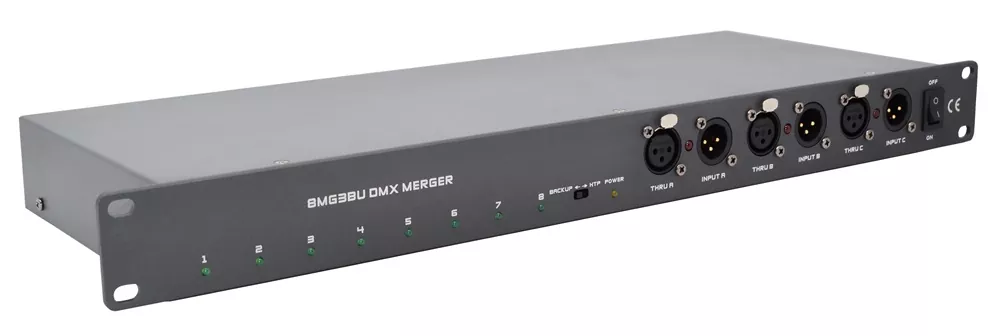
8MG3BU DMX Merger(3-in-8-out DMX combiner)

8MG3BU DMX Merger(3-in-8-out DMX combiner)
DMX Signal Merger: Building an Indestructible “Central Nervous System” for Your Stage Lighting System
Keywords: DMX512 merger, 3-in-8-out DMX combiner, lighting console backup, HTP/LTP priority switcher, opto-isolated signal distributor, stage lighting redundancy, fail-safe DMX solution, concert touring equipment, theater lighting control, architectural lighting system, live event production, TV studio lighting, DMX signal booster, rackmount DMX processor
Preface: The Soul of a Performance Lies in Absolute Control of Light
In the professional stage lighting industry, every precise beam of light and every seamless color transition depends on a stable and efficient DMX512 control network. For lighting designers, system engineers, and technical directors, the most anxiety-inducing moment is when the main lighting console fails unexpectedly during a performance, or when DMX signal interference causes fixtures to flicker or go dark. This not only disrupts the rhythm of the show but can also lead to irreparable reputational and financial losses.
At this critical point, a reliable DMX signal merger becomes the “anchor” of the entire lighting control system. The Model 1380 3-input, 8-output DMX Signal Merger, introduced by Showin Stage Lighting Equipment Co., Ltd., is precisely engineered for this purpose—it is not just a signal merging tool, but a comprehensive redundancy management hub, a signal booster, and a system protection device all in one. This article provides an in-depth look at its core value, technical advantages, and real-world applications for concert touring, theater production, architectural installations, and live event broadcasting.
Why Does Your Lighting System Need a DMX Signal Merger?
In complex stage or permanent installation projects, multiple control consoles often need to work together—for instance, a main console for overall show cues, a backup console for emergency takeover, and an effects console for special sequences. Alternatively, you may need to distribute a single DMX universe to multiple fixture zones simultaneously. However, the DMX512 protocol is a “one-master, multiple-slave” serial communication standard. Simply paralleling the outputs of two or more consoles will cause signal contention, voltage-level conflicts, and can even damage the transceiver chips of your expensive lighting desks.
The core function of a DMX signal merger is to solve this exact pain point. It intelligently receives DMX data streams from up to three input sources (A, B, and C) and, based on user-selectable rules—HTP (Highest Takes Precedence), LTP (Latest Takes Precedence), or BACKUP (priority fail-over) —integrates them into one or more clean, stable, and robust output streams. With eight buffered outputs, this device also doubles as a 1-to-8 DMX splitter, saving you the cost and rack space of a separate distributor.
Our Model 1380 Merger goes beyond basic functionality. It features opto-isolated inputs and outputs, super-driving capability for long cable runs, and has passed CE, UL, and GB 7000.15-2000 safety certifications—making it a globally trusted component for professional lighting rigs.
Core Technology Demystified: Three Operating Modes to Handle All Contingencies
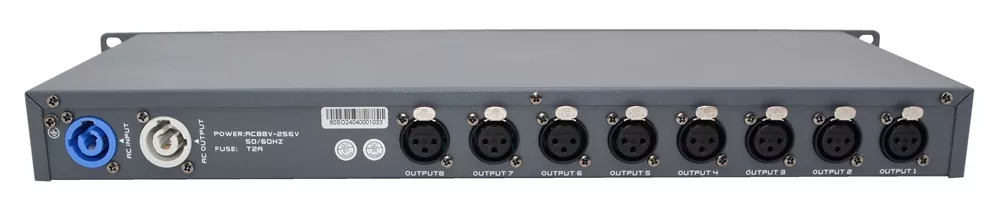
The versatility of the Model 1380 DMX Signal Merger lies in its rear-panel DIP switch, which lets you instantly choose between three distinct priority-logic modes. This flexibility makes it suitable for everything from small theater productions to large-scale music festivals.
- HTP Mode: Highest Takes Precedence — Safety Meets Creative Layering
HTP (Highest Takes Precedence) mode is the industry-standard merging logic for console backup and parallel control. In this mode, the merger continuously scans the same DMX channel across inputs A, B, and C, compares their 8-bit values (0–255), and outputs the highest numerical value to all eight output ports.
Real-World Application: Imagine you have a primary console running the main cue stack and a secondary console controlling a live effects layer (e.g., strobe or pixel-mapping). If the primary console sets the dimmer channel of a fixture group to 60% while the effects console sets that same channel to 0 (intending to turn them off for a moment), the HTP merger will output 60%, keeping the fixtures safely lit. This prevents accidental blackouts during critical transitions. For architectural lighting systems where safety lighting must override decorative effects, HTP is the go-to choice. It is widely documented in DMX512 application notes as the standard for combining multiple sources without losing essential illumination.
- LTP Mode: Latest Takes Precedence — Absolute Responsiveness for Live Control
LTP (Latest Takes Precedence) mode prioritizes action timing over amplitude. Whenever a channel value on any of the three inputs changes—regardless of whether the new value is higher or lower than the others—that most recently updated value is immediately forwarded to the outputs.
Real-World Application: This is the preferred mode for multi-operator live productions such as TV studio lighting, where a lighting director handles overall ambiance while a separate follow-spot operator tracks moving performers. In LTP mode, the follow-spot operator’s pan/tilt and color commands instantly override the main console’s static values, enabling precise, lag-free control takeover. This ensures that the operator who acts last always has the final say—a critical requirement for improvisational or fast-paced live event production. Theatrical lighting designers also favor LTP when using a separate console for special effects during a scene.
- BACKUP Mode: Triple-Redundant Fail-Safe for Mission-Critical Events
This is the ultimate fail-safe mechanism for high-stakes productions where downtime is not an option. In BACKUP mode, the merger assigns a strict priority hierarchy: Input A is the primary source, Input B is the first backup, and Input C is the second backup.
Operational Logic:
As long as a valid DMX signal is present on Port A, the merger replicates that signal to all eight outputs with zero latency.
The moment Port A loses signal—due to console crash, power outage, or cable disconnection—the unit instantly and automatically switches to Port B. This transition happens in microseconds, well below the DMX frame refresh rate, so fixtures see no glitch.
If Port B also fails, Port C takes over immediately, providing a third layer of protection.
Core Value: This three-level backup architecture is the backbone of large-scale concert touring, music festivals, broadcast television, and corporate mega-events. It guarantees that even if your primary lighting desk goes offline, the show continues without a single flicker. Engineers gain precious time to reboot or troubleshoot, while the audience remains completely unaware of any incident. For rental and staging companies, this feature alone makes the Model 1380 an indispensable asset.
Robust Physical Layer Design: Isolation, Driving Power, and Durability
Beyond intelligent logic processing, the electrical and mechanical design of the Model 1380 ensures reliable operation in the harshest touring and installation environments.
- Full Galvanic Opto-Isolation: Protecting Your Valuable Consoles
In large venues with complex power distribution, ground loops, stray voltages, and lightning-induced surges are constant threats. These can travel down DMX cables and destroy the delicate transceiver ICs inside your lighting consoles—repairs that often cost thousands of dollars. The Model 1380 features state-of-the-art opto-isolation technology on every input and output port. This creates a physical (non-conductive) barrier between each signal path. Even if an output cable is shorted to mains voltage or hit by a static discharge, the fault is contained within that isolated loop and will never back-feed into your main or backup consoles. This is equivalent to buying a comprehensive insurance policy for your entire DMX512 ecosystem. - Super-Driving Outputs with Signal Regeneration
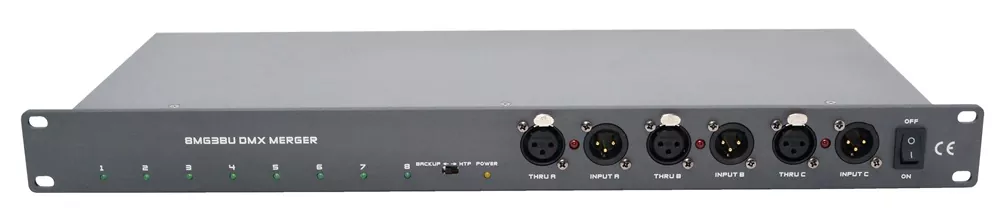
A common pain point in DMX512 installations is signal degradation over long cable runs—typically beyond 100 meters (328 feet), waveform rounding and amplitude droop cause fixture addressing errors, random dimming, or complete loss of control. Each of the eight output ports on the Model 1380 incorporates a high-current line driver that not only amplifies the signal back to full RS-485 levels but also re-shapes the waveform to restore steep rise/fall times. This signal regeneration capability effectively extends the reliable transmission distance to over 300 meters (when using quality cable), eliminating the need for in-line boosters. With eight independent buffered outputs, you can also fan out the merged signal to multiple dimmer racks, LED walls, and moving-light chains simultaneously—all without adding external splitters. - Intuitive Front-Panel Status Monitoring
For touring technicians and house engineers, time is money. The Model 1380 features a clean, informative front panel with real-time LED status indicators:
Yellow Power LED – confirms the unit is energized.
Three Input LEDs (A, B, C) – stay solid green when valid DMX is present; turn off when signal is lost, allowing instant detection of a failing console or broken cable.
Eight Output LEDs (1–8) – illuminate to show active output, confirming that the merged signal is reaching your fixture chains.
With these visual cues, a single technician can diagnose the entire signal path in seconds, drastically reducing downtime during sound checks and live shows.
Details Make the Difference: Industrial-Grade Design and Global Certifications
Universal Wide-Voltage Power Supply
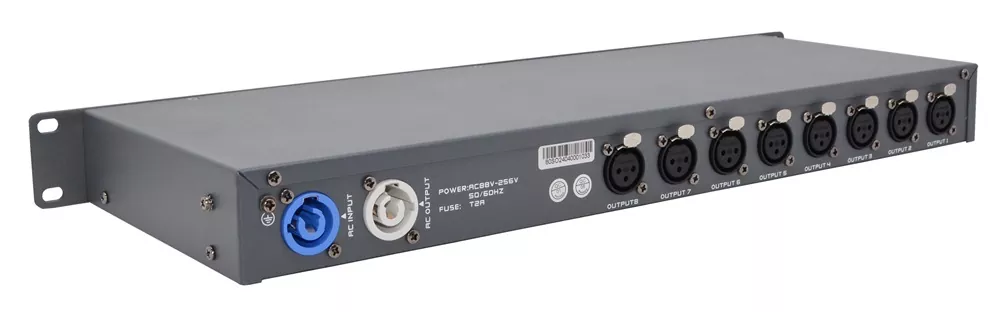
The internal switching power supply accepts an ultra-wide AC input range of 88V~256V, 50/60Hz. This means the Model 1380 operates flawlessly on any mains voltage worldwide—from 110V in North America to 230V in Europe and 220V in Asia—without manual adjustment. It also tolerates voltage sags and surges common at outdoor festival sites where generator power is used.
Rugged 1U Rackmount Enclosure
Housed in a 482mm x 173mm x 46mm (19-inch x 6.8-inch x 1.8-inch) steel chassis, the unit occupies just one rack unit of space. The cold-rolled steel case provides excellent electromagnetic shielding, preventing interference from nearby power transformers or wireless transmitters. Its sturdy construction withstands the bumps and vibrations of touring flight cases, ensuring long-term reliability.
Globally Recognized Safety Approvals
The Model 1380 carries CE certification (mandatory for sale in the European Economic Area), UL standard compliance (widely required in North American installations), and GB 7000.15-2000 (the Chinese national standard for luminaire safety). These independent verifications confirm that the product meets stringent requirements for electrical insulation, fire resistance, and electromagnetic compatibility. For system integrators and lighting rental companies, these certifications are essential bidding documents for government projects, high-end hotels, and international venues.
Comprehensive Application Scenarios: Who Needs This Device?
Large-Scale Concert Touring & Music Festivals – Connect a primary and two backup consoles via BACKUP mode to guarantee uninterrupted performance in front of 50,000+ crowds.
TV Studios & Broadcast Facilities – Enable seamless collaboration between the lighting director’s desk and robotic camera lighting controls using LTP or HTP modes, ensuring smooth on-air transitions.
Theater and Performing Arts Centers – Merge house lighting, follow-spot, and effects consoles while distributing to stage washes and cycloramas via the 8 outputs.
Theme Parks & Nighttime Spectaculars – Integrate multiple show controllers and drive long LED strings and moving heads across large outdoor areas with the isolated, high-drive outputs.
Architectural & Landscape Lighting – Override safety egress lighting with HTP while maintaining artistic color schemes, and use the 8 outputs to cover building facades, bridges, and monuments over long distances.
Rental & Staging Companies – One single 1U device combines a 3-input merger, a priority switcher, and an 8-output distributor—maximizing value, minimizing case weight, and simplifying inventory.
Conclusion: Investing in Stability Means Investing in the Soul of Your Performance
In today’s competitive entertainment industry, a single lighting failure can cost you not just money, but client trust and brand reputation. The Model 1380 3-input, 8-output DMX Signal Merger is far more than a simple combiner—it embodies a professional, fail-safe, and future-proof approach to lighting control. It transforms complex signal management into a plug-and-play experience, neutralizes the risks of console failure and cable damage, and empowers designers and technicians to focus entirely on creative expression.
When you choose the Model 1380, you are selecting:
Triple-redundant fail-over protection for absolute peace of mind;
Eight high-current, regenerated outputs for extensive fixture distribution;
Full opto-isolation for bulletproof hardware safety;
Globally certified quality (CE, UL, GB) for international project acceptance.
Don’t let a fragile DMX512 chain be the weak link in your next production. Upgrade your lighting control infrastructure today, and make every show unfold exactly as you envision—flawlessly, night after night.
Contact us for technical datasheets, custom OEM inquiries, or to order evaluation samples. Experience the rock-solid stability that top touring professionals trust worldwide.
DMX512 merger, 3-in-8-out DMX combiner, lighting console backup, HTP/LTP priority switcher, opto-isolated signal distributor, stage lighting redundancy, fail-safe DMX solution, concert touring equipment, theater lighting control, architectural lighting system, live event production, TV studio lighting, DMX signal booster, rackmount DMX processor, DMX priority merger, backup switcher for lighting, opto-isolated DMX splitter, DMX signal regenerator, 1U rackmount DMX processor, lighting control redundancy, festival lighting gear, DMX512 combiner, three-input eight-output DMX merger, professional stage lighting accessory, DMX failover switch